
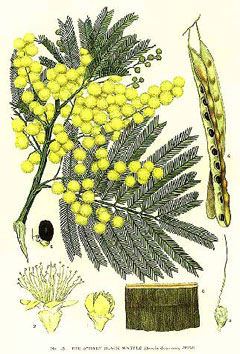
Green Wattle
Latin Name: Acacia decurrens
USDA Hardiness: 6-9
Native Range: AUSTRALASIA: Australia (New South Wales (east), Victoria (east))
Edibility Rating: 2 / 5
Medicinal Rating: 1 / 5
Region:
Family:
Plant Type:
Medicinal Uses
Edible Uses
Edible Parts: Flowers | Edible Uses: GumFlowers - cooked[144]. Rich in pollen, they are often used in fritters. A gum that exudes naturally from the trunk is edible and is used as a substitute for Gum Arabic in making jellies etc[46, 105, 177]. It is insoluble in water[153] and is of low quality[64]. Larger quantities can be obtained by tapping the trunk[64]. Some species produce a gum that is dark and is liable to be astringent and distasteful, but others produce a light gum and this is sweet and pleasant. It can be sucked like candy or soaked in water to make a jelly.[193]. The gum can be warmed when it becomes soft and chewable[193].
Cultivation
Prefers a light sandy loam and a very sunny position sheltered from strong winds[1, 49, 89]. Succeeds in any good garden soil that is not excessively limey[11], it also succeeds in dry soils. Most species in this genus become chlorotic on limey soils[200]. Plants tolerate temperatures down to about -5°c[260]. This species is one of the hardiest members of the genus, it succeeds outdoors in the milder areas of the country, but even in Cornwall it can be killed back to the ground in excessively harsh winters[11]. It will, however, usually resprout from the base. Plants require hot, sunny summers if they are to ripen their wood fully and flower freely. In Britain they tend to do best when grown in coastal gardens in a sunny, sheltered position that is protected from the wind[11]. A fast-growing and very ornamental tree[1, 260], it is closely related to A. dealbata[11]. The cultivar 'Mollis' is notably resistant to honey fungus[200]. This species has a symbiotic relationship with certain soil bacteria, these bacteria form nodules on the roots and fix atmospheric nitrogen. Some of this nitrogen is utilized by the growing plant but some can also be used by other plants growing nearby[200].
Known Hazards
None known
Habitats
Sheltered forests, mainly on shales and sandstone[153]. Usually on cool moist hills and gullies[167].