
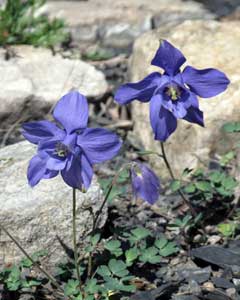
Columbine, Jones' columbine, Blue limestone columbine
Latin Name: Aquilegia jonesii
USDA Hardiness: 3-7
Native Range: NORTHERN AMERICA: Canada (Alberta (southwest)), United States (Montana (west), Wyoming (northwest))
Edibility Rating: 2 / 5
Medicinal Rating: 1 / 5
Region:
Family:
Plant Type:
Medicinal Uses
Edible Uses
Edible Parts: Flowers | Edible Uses: Flowers - raw. Rich in nectar, they are sweet and delightful[172], they make a very attractive addition to mixed salads and can also be used as a thirst-quenching munch in the garden[K].
Cultivation
Prefers a well-drained friable sandy loam with leaf mold[1]. Intolerant of heavy clay[200]. A very ornamental plant[1]. This species deeply resents root disturbance and cannot be transplanted[60]. Most species are short-lived, dying out after 2 - 3 years, though they usually produce seed prolifically[200]. However, they are very apt to hybridize with other members of the genus and so it becomes difficult to keep a species true to type if more than one is grown in the garden[200]. Plants seem to be immune to the predations of rabbits[233]. A greedy plant, inhibiting the growth of nearby plants, especially legumes[54].
Known Hazards
Although no records of toxicity have been seen for this species, it belongs to a family that contains a number of mildly toxic species. It is therefore wise to exercise some caution. The flowers are probably perfectly safe to eat.
Habitats
Usually sub-alpine on scree slopes or in rock crevices in limestone areas only at elevations of 1800 - 3400 metres[60, 270].