
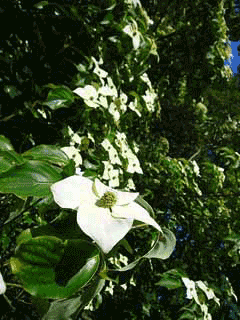
Latin Name: Cornus chinensis
USDA Hardiness: 7-10
Native Range: TEMPERATE ASIA: China (Gansu Sheng, Guangdong Sheng, Guizhou Sheng, Henan Sheng, Hubei Sheng, Shaanxi Sheng, Sichuan Sheng, Xizang Zizhiqu, Yunnan Sheng, Zhejiang Sheng)
Edibility Rating: 2 / 5
Medicinal Rating: 3 / 5
Region:
Family:
Plant Type:
Medicinal Uses
Edible Uses
Edible Parts: Fruit | Edible Uses: The following notes refer to the closely related species C. officinalis, they probably also apply to this species[K]:- Fruit - raw or cooked[105, 177]. The fully ripe fruit is quite pleasant but slightly astringent[K]. It is about 1.5cm long[200]. The fruit contains about 8.6% sugars, 2.9% malic acid, 0.74% ash[179].
Cultivation
An easily grown plant, it succeeds in any soil of good or moderate fertility[1], ranging from acid to shallow chalk[200]. Grows well in heavy clay soils. Succeeds in full sun or light shade[[188]. Prefers semi-shade[219]. Plants are not very cold-tolerant, they succeed outdoors only in the milder areas of the country where winter temperatures do not fall below about -5°c[11, 200]. A specimen growing in a fairly open sunny position at Kew Gardens in April 1999 was about 10 years old and 2 metres tall. It had no sign of flowers, though it is obviously more cold hardy than believed since it has already tolerated temperatures rather lower than -5°c[K]. This species is very closely related to C. mas and C. officinalis, differing mainly in having black instead of red fruit[11, 200]. Plants in this genus are notably resistant to honey fungus[200].
Known Hazards
None known
Habitats
Slopes, margins of mixed forests and dense forests at elevations of 700 - 2500, occasionally to 3500 metres[266].