
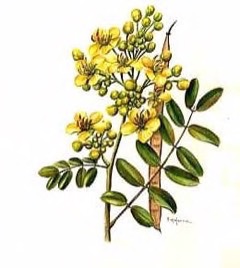
Siamese Senna, Kassod Tree
Latin Name: Senna siamea
USDA Hardiness: 9-12
Native Range: TROPICAL ASIA: Cambodia, Laos, Myanmar (probably native), Thailand (probably native), Vietnam, Malaysia (Malaya (perhaps native)),
Edibility Rating: 1 / 5
Medicinal Rating: 1 / 5
Region:
Family:
Plant Type:
Medicinal Uses
Edible Uses
Edible Parts: Flowers Fruit Leaves | Edible Uses: The young fruits and leaves are eaten as a vegetable. During preparation the cooking liquid is replaced 3 times to remove toxins[303 ]. The flowers and young fruits are used in curries[303 ].
Cultivation
Agroforestry Services: Alley crop Agroforestry Services: Crop shade Agroforestry Services: Nitrogen Agroforestry Services: Windbreak Fodder: Bank Management: Standard Minor Global CropThe tree will grow in a range of climatic conditions, but is particularly suited to the lowland tropics with a monsoon climate, where it can succeed at elevations up to 1,300 metres[303 ]. It grows in areas where the mean annual rainfall ranges from 500 - 2,800 mm with an optimum of about 1,000 mm[303 ]. The maximum length of the dry period should not exceed 4 - 8 months[303 ]. Under semi-arid conditions (rainfall of 500 - 700 mm), it will only grow when its roots have access to groundwater[303 ]. It requires a mean minimum temperature of 20°c, ranging from 14 - 28°c, and a mean maximum temperature of 31°c, ranging from 24 - 36°c[303 ]. It is susceptible to cold and frost[303 ]. Requires a sunny position[303 ]. It grows best on deep, well-drained, fertile soils, but will succeed on degraded, lateritic soils provided drainage is not impeded[303 ]. It grows poorly on infertile, poorly drained podzolic soils[303 ]. It is not tolerant of salinity but is reasonably tolerant of acid soil conditions[303 ]. It prefers a pH in the range 5.5 - 7.5[303 ]. Trees grow fast even in comparatively infertile soils[303 ]. Seedling trees start flowering and fruiting at the age of 2 - 3 years[303 ]. Once established, they flower precociously and abundantly throughout the year[303 ]. Planting density varies according to use. In fuel wood plantations, spacing ranges from 1 x 1 metre to 1x 3 metres. In hedges used for alley cropping or as a shelterbelt, spacing between plants in the row should be 25 - 50 cm[303 ]. Trees respond well to coppicing[303 ]. For the production of fuel wood and charcoal, plantations are generally pollarded or regenerated by coppice leaving 2-3 shoots/stump after 1 year. It has been reported that sapwood should be removed as soon as possible after felling to prevent insect attack of the heartwood[303 ]. The root system consists of a few thick roots, growing to considerable depth, and a dense mat of rootlets in the top 10 - 20 cm of soil, which may reach a distance of 7 metres from the stem in 1 year and eventually a distance up to 15 metres[303 ]. Although many species within the family Fabaceae have a symbiotic relationship with soil bacteria, this species is said to be devoid of such a relationship and therefore does not fix atmospheric nitrogen[755 ]. Flowering Time: Mid Spring Late Spring/Early Summer. Bloom Color: Pale Yellow Bright Yellow. Spacing: 20-30 ft. (6-9 m).
Known Hazards
The sawdust may cause some irritation to the nose, throat and eyes[303 ]. The wood sometimes produces a yellow powder that may cause irritation to the skin[310 ].(Parts of plant are poisonous if ingested)
Habitats
Various types of forests at low elevations[451 ]. Secondary forest formations on the plains[404 ].