
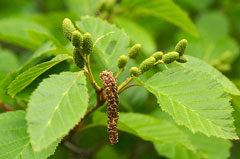
Sitka Alder
Latin Name: Alnus sinuata
USDA Hardiness: 2-9
Native Range: TEMPERATE ASIA: Russian Federation (Habarovskij kraj, Kamcatskij kraj, Magadanskaja oblast, Sakhalin) NORTHERN AMERICA: Canada (Northwest Territories (northwest), Yukon, Alberta (west), British Columbia), United States (Alaska, Idaho, Montana (west), Oregon, Washington, Wyoming (northwest), California (north))
Edibility Rating: 1 / 5
Medicinal Rating: 1 / 5
Region:
Family:
Plant Type:
Medicinal Uses
Edible Uses
Edible Parts: Flowers | Edible Uses: Catkins - raw or cooked. A bitter flavour[172].
Cultivation
Prefers a heavy soil and a damp situation[1, 11]. Grows well in heavy clay soils[11]. Tolerates very infertile sites[200]. This species is closely related to A. viridis and is included as a sub-species of A. viridis by many botanists[11]. A fast-growing but short-lived species, rarely living longer than 50 years[229]. It is a pioneer species of logged or burnt land, often forming dense thickets in low wet areas[229]. This species has a symbiotic relationship with certain soil micro-organisms, these form nodules on the roots of the plants and fix atmospheric nitrogen. Some of this nitrogen is utilized by the growing plant but some can also be used by other plants growing nearby[200]. In garden design, as well as the above-ground architecture of a plant, root structure considerations help in choosing plants that work together for their optimal soil requirements including nutrients and water. The root pattern is branching: a heart root, dividing from the crown into several primary roots going down and out [2-1].
Known Hazards
The freshly harvested inner bark is emetic but is alright once it has been dried[172].
Habitats
Moist woods, stream banks, margins of ponds, to open but moist montane slopes at or near the timber line[60].