
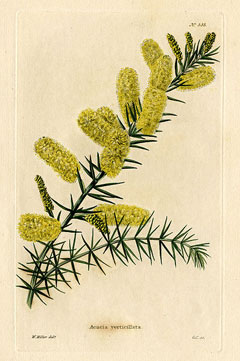
Prickly Moses
Latin Name: Acacia verticillata
USDA Hardiness: 7-10
Native Range: AUSTRALASIA: Australia (Tasmania, New South Wales (southeast), South Australia (southeast), Victoria)
Edibility Rating: 1 / 5
Medicinal Rating: 0 / 5
Region:
Family:
Plant Type:
Medicinal Uses
Edible Uses
Edible Parts: Flowers | Edible Uses: Flowers - cooked[144]. Rich in pollen, they are often used in fritters.
Cultivation
Prefers a sandy loam and a very sunny position[1]. Another report says that it needs some shade[260]. Succeeds in dry soils. Succeeds in any good garden soil that is not excessively limey[11]. Most members of this genus become chlorotic on limey soils[200]. Trees are not very hardy outdoors in Britain, they tolerate occasional temperatures down to between -5 and -10°c, but even in the mildest areas of the country they are likely to be killed in excessively harsh winters[11]. A tree in Cornwall reached a height and width of 6 metres[11]. A fast-growing tree, frequently flowering in a few years from seed[200]. This species is notably resistant to honey fungus[200]. This species has a symbiotic relationship with certain soil bacteria, these bacteria form nodules on the roots and fix atmospheric nitrogen. Some of this nitrogen is utilized by the growing plant but some can also be used by other plants growing nearby[200].
Known Hazards
None known
Habitats
Widespread in saline and submontane tracts[286].